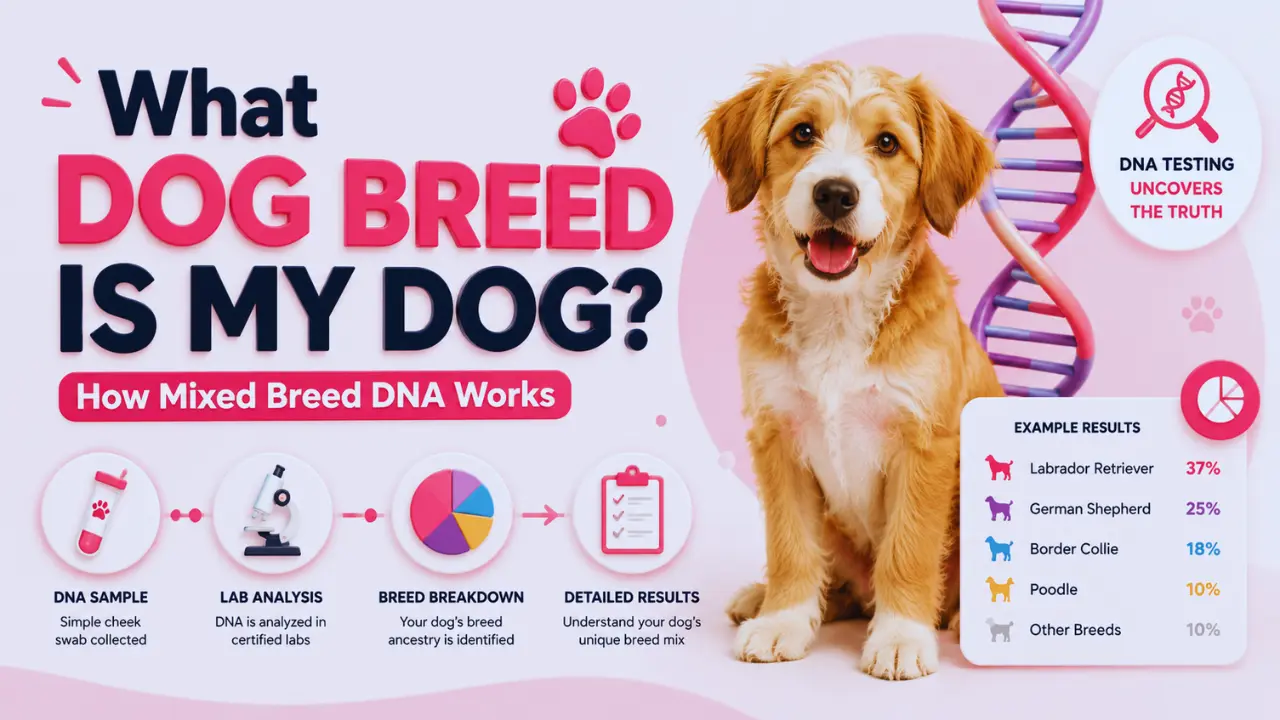
This article explains how canine DNA testing works, what your breed percentage results actually mean, why visual identification fails far more often than people expect, and what DNA results can and cannot tell you about your dog’s behavior and health. By the end, you will have a complete picture of your dog’s background and how to find out if you do not already know.
There is something almost irresistible about looking at your rescue dog and trying to piece together the mystery. The long ears suggest a Basset Hound. The spotted coat resembles a Dalmatian’s. The size screams Labrador. And then the DNA results arrive, and none of those breeds appear anywhere in the report. This disconnect between what a dog looks like and its genetic makeup is more common than most owners expect, and it reveals something fascinating about how genetics and appearance interact in mixed-breed dogs.
What Is Canine DNA Testing?
A canine DNA test is a genetic screening tool that compares your dog’s DNA, collected through a simple cheek swab, against a reference panel of known purebred dogs. The test identifies genetic markers your dog shares with various breeds and calculates a breakdown of your dog’s ancestry. The accuracy of the result depends heavily on how many breeds are included in the reference panel: the more breeds a company has profiled, the more accurately it can identify mixed ancestry.
These tests are legitimate science, not novelty products. The technology behind them is the same SNP (single-nucleotide polymorphism) analysis used in human ancestry testing. However, the results come with real and honest limits. Different companies use different reference panels, which is why the same dog can receive different results from two different services. Neither company is wrong; they are each comparing your dog against a different dataset. It is worth understanding before you place too much certainty on any single result.
How Dog DNA Testing Actually Works
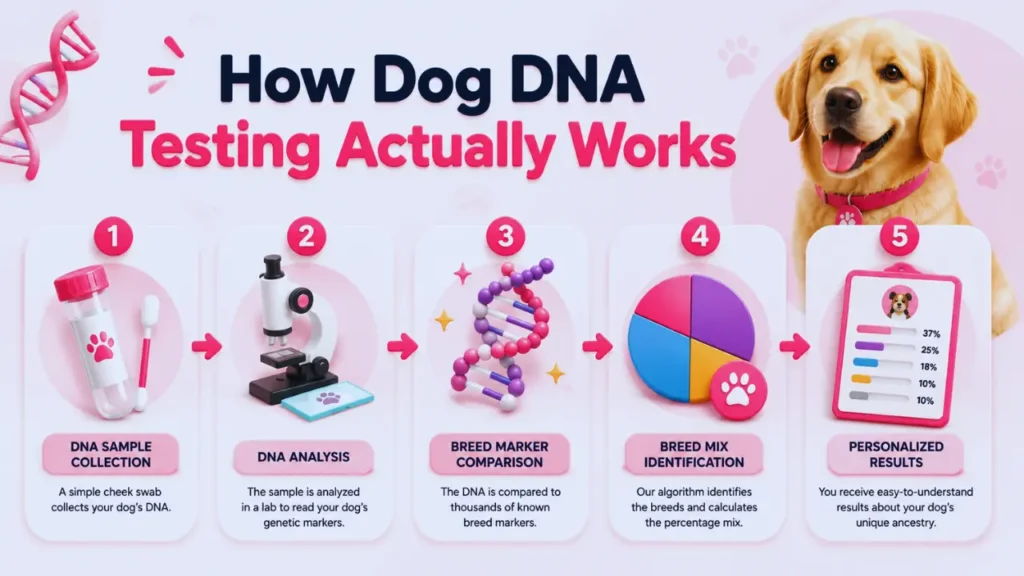
Most people understand that the process involves a swab and a lab, but not what happens between the two. Understanding the process makes the results and their limitations much easier to interpret. Here is what is actually happening from the moment you swab your dog’s cheek.
What the lab compares your dog’s DNA against
The lab extracts DNA from the cells collected in the cheek swab and runs it through a genotyping chip that reads hundreds of thousands of genetic markers called SNPs. Each marker is then compared against the reference panel of purebred dogs. The algorithm identifies which breed profiles the dog’s genetic signature most closely resembles and calculates the statistical likelihood of ancestry from each breed. A larger reference panel means more breeds can be identified, and rarer breeds are less likely to be misclassified as something more common.
What breed percentage actually means
The percentage figures in a DNA result represent generational distance from a purebred ancestor. 50% of a breed means that one parent was purebred. Twenty-five percent means one grandparent was purebred. Twelve and a half percent traces back to a great-grandparent. Anything below 12.5% is typically listed as “trace amounts.” It is real DNA, but from an ancestor several generations back. This is why a dog that looks unmistakably like a Husky might show only 10% Siberian Husky in its results. The visual traits may have come through, but the genetic contribution was small.
Why can two tests show different results for the same dog?
If you send your dog’s DNA to two different companies and receive noticeably different results, this does not mean one test is fraudulent. It reflects the different sizes and compositions of each company’s reference panel. Company A may have 350 breeds profiled; Company B may have 230. If your dog carries ancestry from a breed that is represented in only one company’s panel, the other will assign that percentage to the nearest genetic match. The science is sound, the datasets simply differ.
What DNA results cannot tell you?
A DNA breed breakdown cannot predict your dog’s behavior with certainty. Breed tendencies are real, but they are tendencies, not guarantees. A dog that is 40% Border Collie may or may not have strong herding instincts. A dog with 30% Pit Bull heritage may be one of the gentlest dogs you have ever met. Behavior is shaped by genetics, early socialization, training, and individual personality in ways that percentages cannot capture. DNA results can also flag genetic health predispositions, but these are risks, not diagnoses, and they require vet interpretation rather than internet searches.
Visual identification vs DNA: the accuracy gap
Studies have found that even experienced shelter workers, veterinarians, and dog professionals misidentify the primary breed of mixed-breed dogs up to 75% of the time based solely on appearance. This is a striking finding. It happens because a small number of genes control coat color, texture, and size, meaning these highly visible traits can come from just one or two ancestors and completely mask the dog’s broader genetic background. The dog that looks like a classic Lab-Shepherd mix may carry almost no Labrador or Shepherd genetics at all. Appearance is a poor predictor of ancestry.
Common Mixed Breed Combinations and What They Look Like
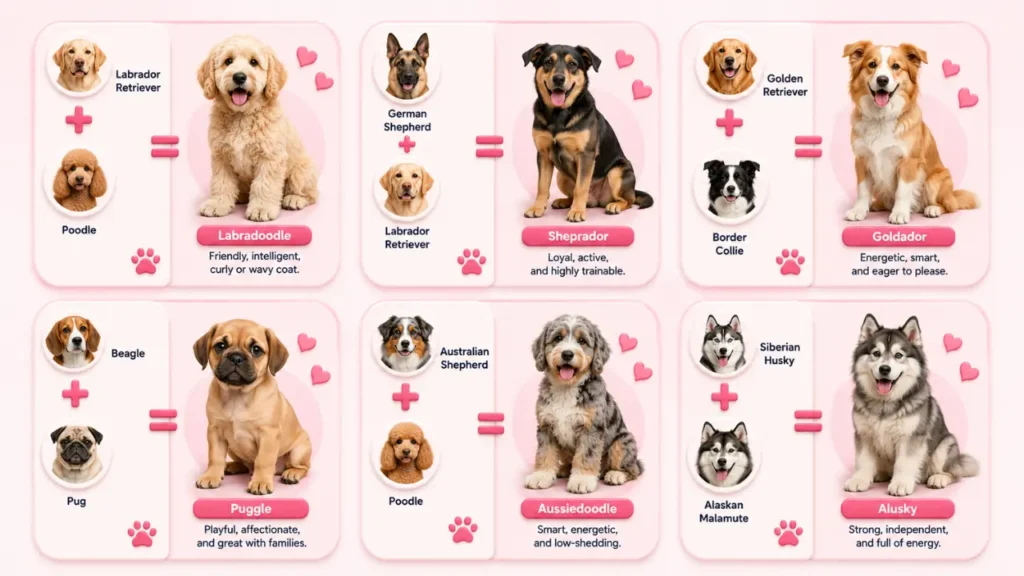
Certain mixed-breed types show up far more frequently in shelters and homes than others, largely because of the prevalence of specific breeds in the general dog population. Understanding these combinations helps explain some of the most common visual misidentifications.
The most common mixed breed types
Lab mixes are among the most common dogs in shelters across the United States. They tend to be medium to large, with short to medium coats, friendly dispositions, and blocky heads. Still, the Lab contribution can range from 50% to less than 15%, and the visual similarity to a purebred Lab does not reflect that range. Pit Bull mixes are similarly widespread and frequently misidentified. The term “Pit Bull” itself is applied to a wide range of dogs that share muscular builds and broad heads but may have no specific breed ancestry in common. Shepherd mixes, Poodle mixes, and Chihuahua mixes make up the most frequent combinations in DNA test results.
Why a dog can look like one breed but test as another
Coat color genes, ear shape genes, and size-determining genes are a small subset of the total genome. They can be inherited from a single grandparent or great-grandparent and expressed visibly even when that ancestor represents a minor percentage of the overall ancestry. A dog that is 48% Poodle and 52% mixed terrier breeds may show almost no Poodle characteristics, such as o curly coat or a Poodle build, because the genes controlling those traits are recessive or were not passed on. Genetics is not a one-to-one mapping between percentage and appearance.
Using the Dog Breed Identifier Calculator
The Dog Breed Calculator is a useful starting point for owners curious about their dog’s likely breed makeup before investing in a full DNA test. You enter the visible characteristics of your dog’s size, coat type, ear shape, and body build, and the tool returns the most probable breed combinations that match that profile. It works from physical traits rather than genetics, so it will not replace a DNA test for confirmed results. But for owners who simply want a starting framework, or for parents helping a child understand their new rescue dog, it is a practical and free first step.
Frequently Asked Questions
How accurate are dog DNA tests?
For well-represented breeds in the company’s reference panel, accuracy is generally high; most major providers claim 90% or above for primary breed identification. Accuracy drops for rarer breeds, regional breeds underrepresented in the panel, and highly mixed dogs with ancestry distributed across many breeds. The breed percentage breakdown is most reliable when a single breed makes up 25% or more of the result. Trace amounts below 12.5% carry more statistical uncertainty.
Can I find out my dog’s breed without a DNA test?
You can make educated guesses based on physical characteristics, size, coat type, head shape, ear set, and tail carriage. Still, the research on visual identification shows these guesses are wrong more often than right. The Dog Breed Calculator can help you explore likely combinations based on appearance. For a result you can rely on, a DNA test is the only method that provides actual genetic data rather than visual inference.
Does breed affect my dog’s behavior?
Breed ancestry can contribute to behavioral tendencies such as herding instincts, prey drive, energy levels, and vocalization. But it is one influence among several. Socialization during puppyhood, training history, individual personality, and the specific combination of genes inherited all play significant roles. A dog that is 40% a breed known for high energy may or may not reflect that trait. Treat breed information as useful context, not a behavioral forecast.
What is the most common mixed-breed dog?
Based on shelter intake data and DNA test results across the United States, Labrador Retriever mixes consistently rank as the most common mixed breed type. American Pit Bull Terrier mixes and German Shepherd mixes follow closely. These three breeds are among the most numerous in the general population, which naturally makes their DNA among the most frequently found in mixed-breed dogs. Regional variation exists; some areas have higher concentrations of specific breeds, reflecting local breeding history.
Is it worth DNA testing an older dog?
Absolutely. The DNA does not change with age. A 10-year-old dog’s genetic ancestry is identical to what it was as a puppy. For older dogs with unknown histories, a DNA test can be genuinely useful for understanding breed-related health predispositions that may become relevant as they age. Knowing that your older dog carries ancestry from a breed prone to hip dysplasia, for example, may inform how you manage their exercise and veterinary monitoring going forward.
Conclusion
Your dog is yours, regardless of the percentages. But knowing what went into creating them is genuinely interesting and occasionally practically useful. The gap between what a dog looks like and what it actually is genetically is one of the more surprising things about mixed breeds. A DNA test closes that gap. The Dog Breed Calculator at Doggy Calculators gives you a useful starting point while you decide.